
Cold water, a gentle cycle, and a shirt turned inside out will stop most shrinkage before it starts. Skip the dryer’s high heat and pull the shirt out while it’s still slightly damp, then let it finish air-drying flat. Most of the damage happens in the first few wash cycles, so getting this routine right from day one matters more than anything you do later.
TL;DR:
- Most cotton shirt shrinkage occurs in the first five wash-and-dry cycles, with minimal changes afterward if high heat is avoided.
- Washing shirts in cold water on a gentle cycle and air-drying flat significantly reduces the risk of shrinkage, especially for lightweight or loosely knit fabrics.
- Using a mesh bag for delicate shirts, turning graphic tees inside out, and avoiding overloading machines protect fibers and maintain fit.
- To partially reverse shrinkage, soak the shirt in lukewarm water with conditioner and gently stretch it before air-drying flat.
- Even pre-shrunk fabrics can shrink up to 5%, so selecting heavier, sanforized, or mercerized cotton improves long-term size stability.
Table of Contents
- Why Do Cotton T-Shirts Shrink in the First Place?
- How Do You Wash a T-Shirt Without Shrinking It?
- What’s the Best Way to Dry a Shirt Without Shrinking It?
- Does Fabric Choice Actually Matter When Buying a T-Shirt?
- Why WattzGood Pays Attention to Shrink-Resistant Fabric
- How Should You Store Freshly Washed Tees to Keep Their Fit?
- Can Ironing Cause a T-Shirt to Shrink Further?
- What Should You Look for When Buying Shrink-Resistant Tees?
- Author’s Take: Practical Rules to Follow for Long-Term Fit
- A Discreet Product Note: WattzGood Tees and Care
- Sources
- FAQ
Why Do Cotton T-Shirts Shrink in the First Place?
Cotton fiber swells when it absorbs water, then contracts as it dries. Toss in the tumbling action of a washer and dryer, and those swollen fibers get pushed and compressed into a tighter weave than they started with. That combination of moisture and mechanical agitation, not heat alone, is what actually pulls a shirt smaller. Heat just speeds up how fast the water leaves the fiber; the real shrinking happens when swelling fibers meet tumbling action.
There’s also a difference between shrinkage that happens at the factory and shrinkage that happens in your laundry room. Manufacturers pre-treat fabric with processes like relaxation drying and compaction to lock in a stable size before the shirt ever reaches a store shelf. Home laundering picks up wherever that factory process left off, and knit fabrics (the kind almost every t-shirt is made from) are inherently more shrink-prone than woven fabrics because of how the yarn loops are constructed.
Here’s the part most people don’t expect: shrinkage isn’t a slow, steady process that keeps eating away at your shirt with every wash.
- Most of the total lifetime shrinkage happens in the first handful of wash-and-dry cycles.
- After that, the fabric reaches something close to a stable, “relaxed” state.
- Later washes cause comparatively little additional change, as long as you’re not running high heat.
The CottonWorks research on dimensional stability backs this up: dimensional stability typically shows up after several full wash cycles, not dozens. That’s actually good news. It means the first five washes of a new shirt are the ones where your habits matter most. Nail those, and the shirt tends to hold its size for the long haul.
How Do You Wash a T-Shirt Without Shrinking It?
Follow these steps in order, and you’ll cut your shrinkage risk dramatically on nearly any cotton or cotton-blend tee.
- Read the care label first. Every manufacturer prints its own tolerance for heat and agitation on the care label, like the examples found on the Warning New and Fragile Baby Bodysuit, and the label overrides any general rule you’ve read online.
- Sort by fabric and weight. Wash lightweight jersey tees separately from heavy fleece or denim. Mixing weights means one fabric gets over-agitated trying to accommodate the other.
- Set the machine to cold water, roughly 86°F (30°C), on the gentle or delicate cycle. Cold water limits fiber swelling, and a gentle cycle limits the tumbling that locks that swelling into a smaller shape.
- Use a low spin speed. High-speed spinning wrings and twists the fabric hard enough to distort the knit, even before it hits the dryer.
- Turn printed or graphic tees inside out. This protects the print from cracking and keeps the outer fibers from taking the brunt of the agitation.
- Drop lightweight or loosely knit shirts into a mesh laundry bag. Loose knits snag and stretch against zippers, buttons, and other garments; a mesh bag isolates them.
- Use a mild detergent and skip the bleach. Harsh detergents and bleach break down fiber structure over time, which makes fabric more prone to distortion under heat and water.
- Don’t overload the machine. A stuffed drum forces more friction between garments, which is exactly the kind of extra mechanical action that speeds up shrinkage.
This lines up with the Whirlpool laundry guidance on cold-water washing, gentle cycles, and inside-out drying for delicate knits, which remains some of the most practical, field-tested advice available for home laundering.
Pro Tip: Keep a mesh bag by your hamper specifically for tees you care about. When you don’t have to think about sorting at wash time, you’re far more likely to actually protect the shirts that matter.
What’s the Best Way to Dry a Shirt Without Shrinking It?
Drying does more damage to a t-shirt’s fit than washing does, mostly because dryers combine heat with continuous tumbling for 30 to 60 minutes straight. That’s a long window for a damp, swollen fiber to contract under mechanical stress.
- Air-dry flat whenever possible. Laying a shirt flat on a towel or drying rack prevents the shirt’s own wet weight from stretching it out of shape, which can happen if you hang a heavy jersey tee on a hanger.
- If you use the dryer, choose low heat or the air-fluff setting. Skip anything labeled high heat or “cotton sturdy,” which is built for towels and denim, not tees.
- Pull the shirt out while it’s still slightly damp. Let it finish drying flat on a towel or rack instead of running a full dry cycle. This single habit prevents more shrinkage than almost any other change you can make.
- Use a moisture-sensor cycle if your dryer has one. These cycles stop automatically once the load hits a target dryness, which helps you avoid the overdrying that a fixed-timer setting can’t detect.
Air-drying flat also preserves shape better than hang-drying for jersey knits, since wet cotton jersey elongates under its own weight when left on a hanger.
If a shirt already shrank, there’s a reasonable shot at partial recovery. Soak it in lukewarm water mixed with a small amount of hair conditioner for about 15 to 20 minutes. The conditioner helps relax the cotton fibers. Lay the shirt flat on a dry towel, gently stretch it back toward its original dimensions, and consider weighting the edges with something like books or cans while it air-dries. According to Real Simple’s unshrinking method, this approach can restore a meaningful amount of size, though full factory dimensions rarely come back completely.
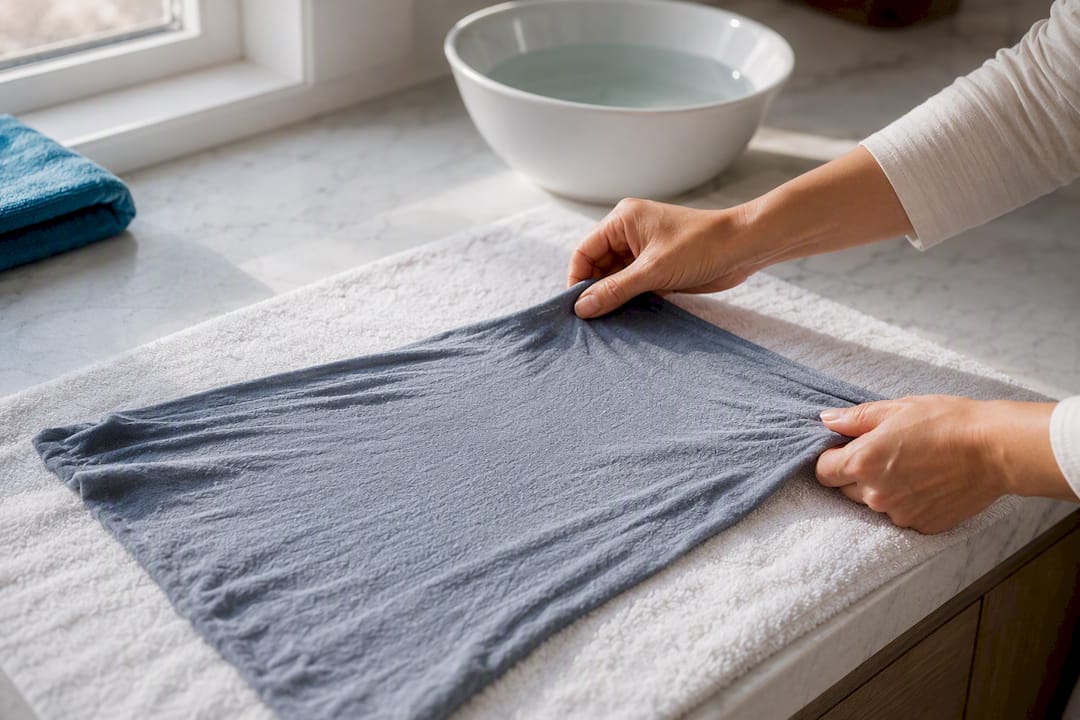
Pro Tip: Don’t expect miracles on shirts with heavy screen-printed graphics or bonded appliqués. The adhesive backing on prints resists stretching, so the fabric around it can end up puckered even after a successful unshrinking attempt.
Does Fabric Choice Actually Matter When Buying a T-Shirt?
It matters more than most shoppers realize. “Pre-shrunk” on a tag doesn’t mean shrink-proof. It means the fabric went through a manufacturing process, often called sanforizing, that reduces how much it will shrink at home. Even sanforized cotton typically carries residual shrinkage of 1% to 5%, depending on the finish quality and how the fabric was constructed.
Blended fabrics behave differently than 100% cotton. Polyester fibers don’t absorb water and swell the way cotton does, so a cotton-polyester blend shrinks noticeably less than a pure cotton tee under identical wash conditions. That’s part of why so many athletic and performance tees lean on blends: stability under repeated washing is a design goal, not an accident.
Construction matters too:
- Heavier, tighter-knit tees (think higher ounce-per-square-yard fabric) resist distortion better than thin, loosely knit shirts.
- Lightweight, open-knit tees, the kind that feel soft and drapey right out of the package, are the most shrink-prone in almost any wardrobe.
- Look for “preshrunk” or “sanforized” on the label, along with a listed fabric weight, since a heavier fabric spec is a decent proxy for dimensional stability.
If a shirt lists no fabric weight and no finishing terms at all, treat the sizing as a rough estimate rather than a guarantee, and wash it cold on the gentle cycle from day one.
Why WattzGood Pays Attention to Shrink-Resistant Fabric
Apparel built for people who actually wear it every day has to hold its fit, not just look good on a hanger. WattzGood designs EV-themed and sustainability-focused tees for eco-conscious shoppers and EV enthusiasts, and part of getting that right is choosing fabric and construction that hold up under normal home laundering.
Product pages spell out care instructions clearly instead of burying them, which matters given how much shrinkage risk comes down to that first wash. Shirts like the EV over Gas tee and the Wattz Logo Tee are printed graphics, so following the inside-out, cold-wash routine protects both the print and the fit. The Plaid Tee uses a different weave structure, and checking its label for the recommended water temperature and cycle before the first wash sets it up to hold its shape for years, not just weeks.
How Should You Store Freshly Washed Tees to Keep Their Fit?
What you do after the shirt comes out of the dryer (or off the drying rack) has more influence on long-term fit than most people assume. A shirt that survived a perfect wash can still stretch out of shape sitting on a hanger for months.
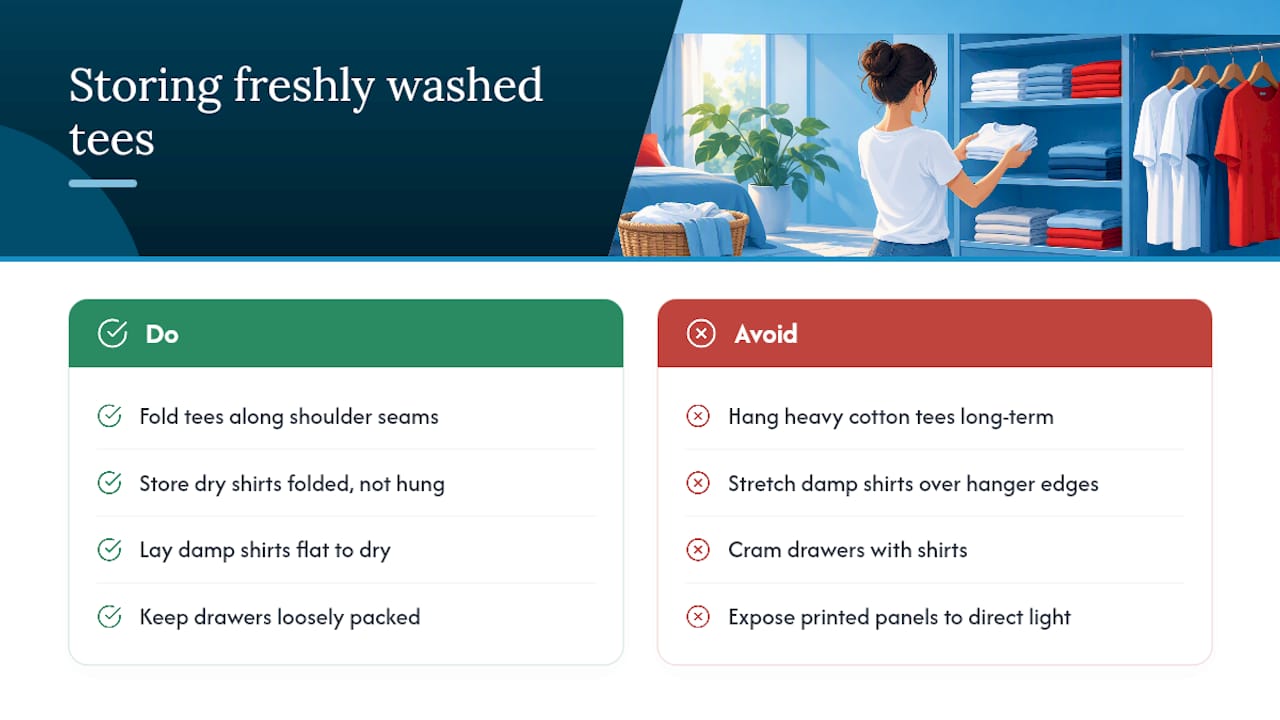
Hanging heavy cotton tees for extended periods lets gravity slowly pull the shoulders and neckline out of their original shape, especially once the fabric is fully dry and has lost the elasticity it had right out of the wash. Folding is usually the better call for jersey knits. Fold along the shoulder seams rather than in the middle of the chest, which avoids creasing the print area on graphic tees.
Avoid cramming a drawer so full that shirts stay under constant pressure between washes. Compressed fabric develops set-in creases that behave a bit like a mild, localized shrink: the fibers hold that folded shape and resist relaxing back out.
Don’t stretch a damp shirt over a hanger or drying rack edge to speed up drying time. Pulling wet cotton to fit a hanger shape works directly against everything you did during the wash to keep the fibers relaxed and true to size. Lay damp shirts flat until they’re dry, then fold them once they’ve settled.
For shirts with prints, like most graphic tees, folding also beats hanging for another reason: it keeps the printed panel flat and out of direct light, which slows fading alongside preventing the stretch-related distortion hanging can cause.
Can Ironing Cause a T-Shirt to Shrink Further?
Ironing itself doesn’t typically cause new shrinkage the way washing and drying do, but the wrong heat setting can undo some of your careful laundering work. High heat applied directly to cotton, especially while the fabric still holds residual moisture, can cause additional fiber contraction in small, localized areas.
Set the iron to the cotton or medium setting rather than the highest setting, and always check the shirt’s care label first since fiber content changes the safe threshold. A cotton-polyester blend needs a lower setting than 100% cotton, because polyester can scorch, glaze, or shrink slightly under heat that cotton alone would tolerate just fine.
Iron printed tees inside out, or place a thin cloth between the iron and any graphic. Direct heat on a printed panel can crack or melt the print, and the localized heat can also pucker the fabric right around the design, which reads as a shrunk or warped section even when the rest of the shirt is fine.
Use a lower heat setting for waistbands, cuffs, and seams, since these areas have layered fabric that holds heat longer than a single layer. Add a light mist of water rather than a heavy soak. Oversaturating cotton before ironing means the iron’s heat has to work harder to evaporate that moisture, which increases the odds of localized contraction in exactly the fibers you’re trying to smooth out.
What Should You Look for When Buying Shrink-Resistant Tees?
Reading past the marketing language on a hangtag takes a little practice, but a few specific terms tell you far more than “pre-shrunk” alone.
Look for sanforized or mercerized cotton specifically, rather than a generic “preshrunk” claim with no process named. Mercerization strengthens and stabilizes cotton fiber at the chemical level, while sanforizing is a mechanical compaction process done at the finishing stage. Either one, and especially both together, points to a manufacturer that invested in dimensional stability rather than just printing a reassuring word on the tag.
Check the listed fabric weight in ounces per square yard when it’s available. A heavier weight, generally above 5.5 oz/yd², tends to hold its shape through more wash cycles than a lightweight 4 oz/yd² tee, simply because there’s more fiber mass resisting the pull of water and agitation.
Favor ring-spun or combed cotton over open-end cotton when the option is listed. These spinning methods produce a tighter, more uniform yarn that resists the kind of fiber shifting that leads to shrinkage and pilling over time.
Don’t expect any label claim to mean zero shrinkage. Even well-finished, sanforized cotton carries a small residual shrink potential, so budget for that when you’re deciding on sizing, particularly with shirts you plan to wear tight or fitted.
Author’s Take: Practical Rules to Follow for Long-Term Fit
Run every tee through the same mental checklist before it goes in the machine: check the label, cold wash, gentle cycle, air-dry or pull it while damp. That’s it. It sounds almost too simple to work, but it’s the routine, not any single miracle product, that keeps a shirt’s fit intact for years.
Occasional dryer use on a heavier cotton-blend tee won’t ruin it overnight, but it does chip away at dimensional stability faster than air-drying. Keep a mesh bag for your delicate or graphic tees and a labeled shelf for the heavier ones. Small habits, repeated consistently, beat any single “best practice” you follow once and forget.
— Quincy
A Discreet Product Note: WattzGood Tees and Care
WattzGood built its tees for people who actually wear their EV pride on repeat, not just for one photo before the shirt gets stiff and small. Every product page lists care instructions clearly, so you’re not guessing at wash temperature or dryer settings after checkout.

If you’re shopping for a shirt that’s easy to keep in shape, the EV over Gas tee is a solid starting point. Turn it inside out before washing to protect the graphic, and it holds up well through a cold, gentle cycle. The Plaid Tee uses a different weave, so give its label a quick look before the first wash to lock in the right water temperature. The Wattz Logo Tee follows the same printed-graphic care logic as the EV over Gas design: cold water, gentle cycle, inside out.
Browse the full lineup at WattzGood and pick a tee that matches your style. Every product page includes the care details you need to keep it fitting the way it did the day it arrived.
Sources
- CottonWorks technical bulletin: shrinking and skewing
- How to Prevent Clothes from Shrinking — Whirlpool
- Real Simple: how to prevent cotton shrinking and unshrink tips
FAQ
How Do I Stop My T-Shirts From Shrinking?
Wash cold on a gentle cycle, turn the shirt inside out, and skip high heat in the dryer. Pull it out while still slightly damp and let it finish drying flat, since most consumer shrinkage guidance points to heat and aggressive tumbling as the main triggers, not the detergent you use.
Why Do My T-Shirts Keep Shrinking in the Wash?
Shrinkage happens when water swells cotton fibers and then washer or dryer agitation locks that swelling into a tighter knit as it dries. Most of that change occurs in the first few wash-and-dry cycles, so a shirt that’s been through five or more careful washes tends to stabilize.
Is There a Way to Unshrink T-Shirts?
Soak the shirt in lukewarm water with a small amount of hair conditioner to relax the fibers, then gently stretch it flat on a towel and let it air-dry. Real Simple’s testing found this can restore a meaningful amount of size, though shirts with heavy prints or thick construction rarely return to their exact original dimensions.
Do Cotton Shirts Eventually Stop Shrinking?
Yes. Dimensional stability typically sets in after several full wash-and-dry cycles, once the fiber has relaxed into a settled state. After that point, additional shrinkage becomes minimal as long as you avoid high heat and rough handling going forward.
Does Pre-Shrunk Cotton Still Shrink?
Yes, pre-shrunk or sanforized cotton typically still shrinks by about 1% to 5%, depending on the finish and how the fabric was constructed. It’s a meaningful reduction from unfinished cotton, but it isn’t a guarantee of zero shrinkage, so cold-water washing still matters.